Chapter 2: The Red Garden
The transition out of near-light speed was not a glide; it was a violent resurrection.
The transition out of near-light speed was not a glide; it was a violent resurrection.
[Initiating wake-up sequence,] the AI’s voice cut through the dark, synchronized with the screaming of the hull as the braking burns began.
Steam hissed from the vents of the command pods on the bridge. For Dan, it wasn’t a gentle rising from sleep; it was an industrial-scale resuscitation. The “thaw-needles” retracted from his spine with a wet, mechanical click, and he convulsed, his body remembering the pain of existence before his mind caught up.
He collapsed forward, the restraint harness catching his skeletal frame. His lungs burned, the Gene Rot flaring in protest against the sudden, brutal return of inertia.
“Status,” Dan rasped, the taste of copper and cryo-fluid sharp in his mouth.
Ambrosio III was already moving. His genetically sculpted frame handled the thaw better than Dan’s decaying biology. He pulled himself from his pod, stumbling slightly as the artificial gravity fluctuated, and moved to help Dan.
[Deceleration complete,] the AI replied. Its holographic avatar flickered with static—a digital bruise—before sharpening into focus. [Velocity relative to Teegarden b is zero. Orbit achieved. But the stress on the Core was terminal. The NLS manifold has warped beyond recalibration. The drive is dead, Dan. We’re one-shot, and we just took it.]
Dan waved off Ambrosio’s hand, forcing himself to sit up. “We’re here. That’s what matters.”
Ambrosio III moved to the viewport, wiping the condensation from the glass. “Look at it.”
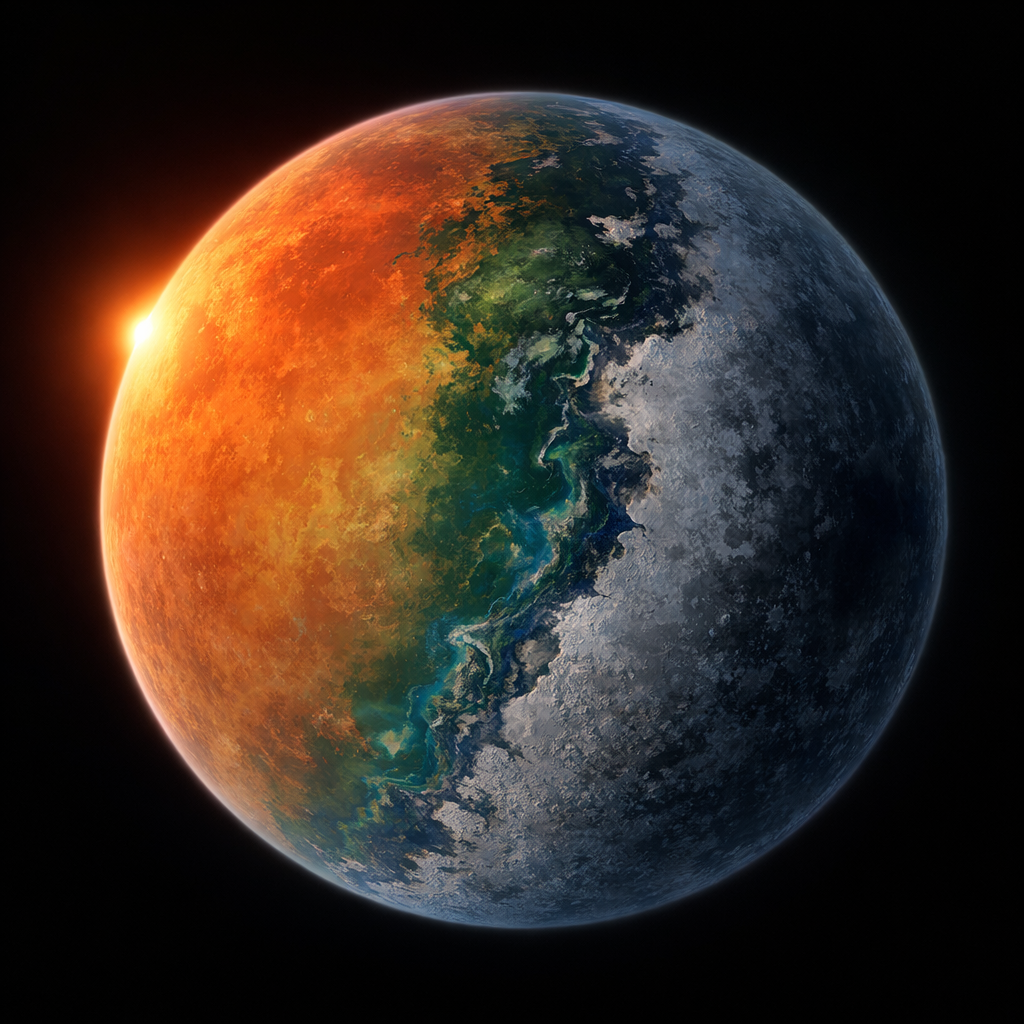
It was a bruised jewel, bathed in the crimson twilight of its red dwarf sun. Instead of Earth’s familiar blue, the oceans were a deep, dark indigo, and the continents were swathed in a lush, undulating carpet of violet and black vegetation.
But above it all hung a shimmering, translucent film—an atmospheric shield that rippled like oil on water. It reflected the blood-light of the star, obscuring the surface details in a haze of distortion.
“What a beautiful planet,” Ambrosio III whispered, his voice cracking with a mix of awe and exhaustion.
[Yeah,] then the AI muttered sarcastically. [A new one to corrupt.]
“I think we’ll be busy just surviving it,” Ambrosio III countered. He tapped a floating interface, his fingers moving with practiced speed. “That shield explains the silence. Standard sensors are bouncing right off it. Atmospheric density is high, but we’re blind to the surface. It would have been convenient if the Sails of Hope had a Quant-Com onboard. We could have seen this in real-time before we burned our only bridge.”
[Spoiled child,] the AI chided. [They got here on solar sails and ancient nuclear propulsion. They didn’t have the luxury of quantum entanglement. They likely had to land just to see what was down there. Give the ghosts a break.]
“Scans detect a ship,” Dan interrupted, his voice regaining its command cadence despite the tremor in his hands. “High orbit. Equatorial inclination. No thermal bloom.”
[It’s the Sails of Hope,] the AI confirmed, overlaying a tactical wireframe on the main viewport. [She’s drifting. Life support is on a skeletal cycle. No reply to hails.]
“Likely they are in stasis as per protocol,” Dan said, though his eyes narrowed. “Or they’re dead. I’m not risking a biological breach on the Epilogue with a physical boarding. Junior, prep the Neural Link. I’m sending a spectral-frame bot over there.”
The Ghost of Hope
Boarding the Sails of Hope was a disembodied experience, a ghost visiting a graveyard.
Dan sat in the command chair of the Epilogue, a heavy VR visor strapped over his eyes. Through the optical sensors of the maintenance bot, the interior of the sister ship appeared in grainy monochrome, illuminated only by the bot’s shoulder lamps.
The air inside was thin, the pressure critical. Dust motes danced in the light beams, settling on walls covered in a strange, dried organic film—like black veins that had tried to grow through the metal bulkheads and died when the heat failed.
“The ship is a tomb,” Dan’s voice echoed in the Epilogue’s bridge, though his consciousness was floating through the silent corridors of the Sails. “No active life signs. Power is diverted entirely to the Cryo-Deck.”
He navigated the bot through the twisting hallways, magnetizing its boots to the floor to counteract the failing gravity. The silence was absolute, broken only by the magnetic clank of the bot’s steps. He found the primary commander’s pod, coated in a layer of frost so thick the bot had to scrape it away with a manipulator arm.
Inside, a woman lay frozen in time. Her skin was pale, but it lacked the tell-tale grey map of advanced corruption that plagued Dan’s crew.
Dan engaged the manual override with the bot’s interface tools. The pod hissed, ancient seals breaking with a sound like a cracking whip. Steam billowed, instantly freezing in the cold air.
“A bot?” the woman rasped as her eyes snapped open. She didn’t gasp; she tensed, squinting at the skeletal machine looming over her.
“I am Commander Dan of the Epilogue,” Dan projected his voice through the bot’s speakers. “We are a relief vessel. We are here to retrieve you.”
“I am Silvia,” she whispered, her voice a jagged shard of glass. She tried to sit up but collapsed back against the cushioning. “The Commander is dead. I have taken command.”
“Why? What happened here, Silvia?”
“A breach,” she said, her eyes darting to the sealed, welded blast doors at the end of the corridor. “We sent a shuttle down. It came back… we thought it was clean. We scanned it. But the sample… the black fluid… it permeated the containment glass. It didn’t break it; it became it.”
She shuddered, the memory cutting through the fog of cryo-sickness. “It got into the ventilation. It tried to merge with the crew. It turned them into… glass statues that screamed until they shattered. I vented the lower decks. I flushed the atmosphere. But I couldn’t be sure, Dan. I couldn’t risk bringing it back to Earth. So I locked us down. The quarantine is absolute.”
“We aren’t going back to Earth, Silvia. Earth is gone,” Dan said softly. “But I need your logs. I need to know what that thing is.”
“AI, transmit ship logs,” Silvia ordered, her hand trembling as she keyed the command on her pod’s internal panel. “Archive access code: 0890AB.”
She looked at the bot’s lens, her eyes pleading. “Put me back. If you take me out, if there’s even one spore on this suit… I won’t let you risk your ship. Put me back!”
“Silvia, we can treat—”
“Do it!” she screamed, her hand hovering over the emergency seal. “Whatever is down there… it doesn’t just kill. It rewrites. Don’t let it touch you.”
Dan hesitated, the soldier in him wanting to save her, the commander knowing she was right. He keyed the command. The glass slid shut. The frost returned, sealing her warning in ice.
The Necrotic Feedback
Back on the Epilogue, the AI decrypted the data packet Silvia had sent. The bridge was filled with the flickering images of the Sails’ final days, rendered in the cold blue light of a forensic playback. Ambrosio III stood centered in the display, his eyes darting between three separate data streams as he tried to map the planet’s atmospheric composition against the biological carnage on screen.
“Sitrep?” Dan asked, pulling the VR visor off and rubbing his eyes. The headache from the link was a dull throb behind his temples.
[I’m seeing a catastrophic biological event,] the AI said, its voice devoid of its usual snark. [The first team landed in a high-density vegetation zone. They were approached by unidentified organisms—black, fluid-like masses. Initial contact seemed predatory, but the results were… anomalous.]
The footage showed the Sails shuttle descending through the atmospheric film, their sensors blinding out until the last second. They didn’t land in a clearing; they landed in a meat grinder. The camera shook as troopers disembarked into a chaotic skirmish between glowing, armored humanoids and oily, black masses. One of the masses bypassed the fight and latched onto a Sails trooper. The parasite merged with the suit’s breach point, its tendrils threading through the trooper’s spinal column in a flash of bioluminescent light.
[The trooper went into immediate distress,] the AI narrated, zooming in on the extraction unit. [And here is the fatal error. The support bot, following medical protocol, grabbed him and hauled him back to the shuttle. It didn’t register the parasite as a separate entity. It just saw a dying crewman and brought the nightmare home.]
“Look at the trooper’s vitals,” Ambrosio III pointed to the sensor data he had just isolated. “Energy output is spiking. It looks like a high-speed cellular rewrite. I’ve already adjusted the ship’s sensors to track these specific bio-electrical signatures. If they move on the surface, we’ll see them now.”
The trooper on the screen didn’t become a super-soldier. Instead, his body began to fail at a molecular level. His bones underwent a rapid, violent calcification—turning into a glass-like substance—and his skin became translucent. Within seconds, he was glowing with an unnatural, sickly heat before his cellular walls simply… exploded.
[The parasite is trying to interface with the host’s nervous system,] the AI explained, its voice tight with analysis. [But it’s hitting a wall. Our Gene Rot—the corruption—is creating a massive biochemical resistance. It’s like trying to plug a high-voltage reactor into a short-circuited grid. The feedback loop is instantaneous.]
“Is it a virus?” Ambrosio III asked, already pulling up the planetary topography. He was looking for civilization, for the origin of the radio interference that had plagued the Sails.
[No. It’s more like an invasive neural architect,] the AI replied. [It wants a clean host to rebuild. But our DNA is too ‘dirty.’ The corruption acts as a toxin to the parasite’s synthesis process. It tries to fix us, the fix fails, and the resulting energy surge vaporizes the host from the inside out.]
Dan looked at his own grey-veined hand. The Rot that was killing him was, ironically, the only thing that might save him from this new nightmare. “So we’re too broken to be useful to it.”
“I’ve identified a massive geothermal signature in the southern hemisphere,” Ambrosio III interrupted, his voice pulsing with a mix of excitement and dread. “It’s not volcanic. It’s structured. There are obsidian spires reaching into the upper atmosphere. If there’s anyone left who knows what this ‘architect’ is, they’re down there.”
“Fine,” Dan said, standing up. The decision was made. “We’ll use the Sails’ bots. Junior, finish the remote link calibrations. Augment them for remote capability. The Quant-Com should be able to punch through that shield where their radios failed. I’m not setting foot on that planet until we know exactly what kind of fire the locals are using to fight this… whatever it is.”
“I’m already syncing the Quant-Com to the bot’s neural lace,” Ambrosio III said, his focus absolute. “Give me ten minutes, and I’ll have a set of eyes in that city. And Dan? I’m getting you those samples.”
“Fine,” Dan growled. “But if the sample triggers a feedback loop on my ship, I’m venting the hangar.”
The Manifest
While the Quant-Com synced with the bot’s neural lace, the adrenaline of the arrival began to fade, replaced by the dull ache of the Gene Rot. Dan slumped back in the command chair, accepting a pouch of nutrient paste from a dispenser arm. It tasted like chalk and copper, but he forced it down.
“Status on our own assets?” Dan asked, wiping his mouth. “If we have to go down there in force, I need to know what we brought. We left in a hurry.”
[Manifest is secure,] the AI replied, projecting a list onto the side monitor. [We have the core leadership from Earth—scientists, engineers, the last of the tactical command. Three heavy-loader bots. The ship’s skeleton crew. Ten from your personal security detail.]
The list scrolled, highlighting a specific entry in red.
[And one squad of AlterTerra.]
Dan raised an eyebrow, looking at Ambrosio III, who was busy calibrating the VR interface. “AlterTerra? You sure have guts bringing those things with you. They’re bio-weapons, not soldiers. Relics of the Martian Wars.”
“I’m no soldier,” Ambrosio admitted, not looking up from his work. “But given what happened to the Sails, I want the best. If the planet bites, I want to bite back.”
“Is it enough to start anew?” Dan asked, eyeing the long list of cryo-pods on the screen.
“Well,” Ambrosio smirked, finally turning to face him. “If it’s males only that you want, that is.”
[Majority of the sleepers are female,] the AI interjected.
“Why is that?” Dan asked.
[Don’t be suspicious of Thirdy here,] the AI said dryly. [It’s just that there is no cure for the female genome yet. So we brought more guinea— ehem—I mean, subjects.]
Dan choked on his nutrient paste. “Guinea pigs?”
“We need samples,” Ambrosio corrected quickly, his tone serious. “And I can’t get them from males, can I? We have a limited amount of synthesis material on hold. Sibyl and the rest can make more after they are cured. Otherwise, saving them is meaningless. We need a population, Dan.”
“Now I feel like you’re the Commander here, not me,” Dan sighed, rubbing his temples.
“My wife is my Commander, Commander,” Ambrosio said softly.
“Right. Sibyl.” Dan looked at the younger, perfect copy of his old friend. “Thanks for bringing the AlterTerra, though. At least I can feel some action if needed.”
“Whatever. Just give me your access code later so I can make you a body,” Ambrosio gestured to his own sculpted physique. “Look at this. What do you call this? Perfection.”
“Nope,” Dan tapped his chest, where his heart beat with an irregular, dying rhythm. “This body is still fine. Give me a finished product when you figure out the bugs. Besides… sorry, I’m not into men.”
They laughed in unison, a rare, human sound in the sterile belly of the ship, before the console beeped.
[Sync complete,] the AI announced, cutting the levity short. [Quant-Com link established. We are live.]
The Eye of the Needle
[Deploying aerial reconnaissance swarm,] the AI continued, the main screen splitting into a dozen feeds. [Penetrating the atmospheric shield in 3… 2… 1…]
The viewport, previously obscured by the shimmering interference of the planetary shield, flickered. The static cleared, replaced by crystal-clear high-altitude feeds.
“We’re through,” Ambrosio III breathed, watching the telemetry. “The quantum scanners are slicing right through that film like it’s not even there. Standard radio is dead, but entanglement? It’s singing.”
On the screen, the drones—small, agile units deployed from the Sails’ retrofitted hangar—dove beneath the cloud layer. The world below revealed itself in stunning detail.
“Look at that,” Dan pointed to the feed. “It’s not just jungle. It’s civilization.”
The scanners mapped vast, spiraling cities built from dark, glassy stone, integrated seamlessly into the violet vegetation. Heat signatures pulsed in the streets—thousands of them.
[Preliminary scans complete,] the AI reported. [I’m detecting high-density population centers in the temperate zones. And… massive thermal anomalies at the equator. It looks like a war front.]
“So they aren’t just surviving,” Dan murmured, his eyes scanning the tactical map building in real-time. “They’re fighting. And now, we have a front-row seat.”