Chapter 1: The Epilogue
The Epilogue did not so much sail through the void as it ground through it.
The Epilogue did not so much sail through the void as it ground through it.
It was a vessel born of a dying species. Generations of aggressive CRISPR patching had resulted in “The Rot”—a cascading corruption of the human genome. Every attempt to fix the bugs of mortality had introduced new errors, unraveling evolution into a slurry of necrotic tissue. To prolong their existence, humanity had been forced to carve away their failing biology, replacing limbs and organs with chrome and ceramic, becoming a race of desperate cyborgs clinging to life. But even the machines could not halt the genetic decay forever.
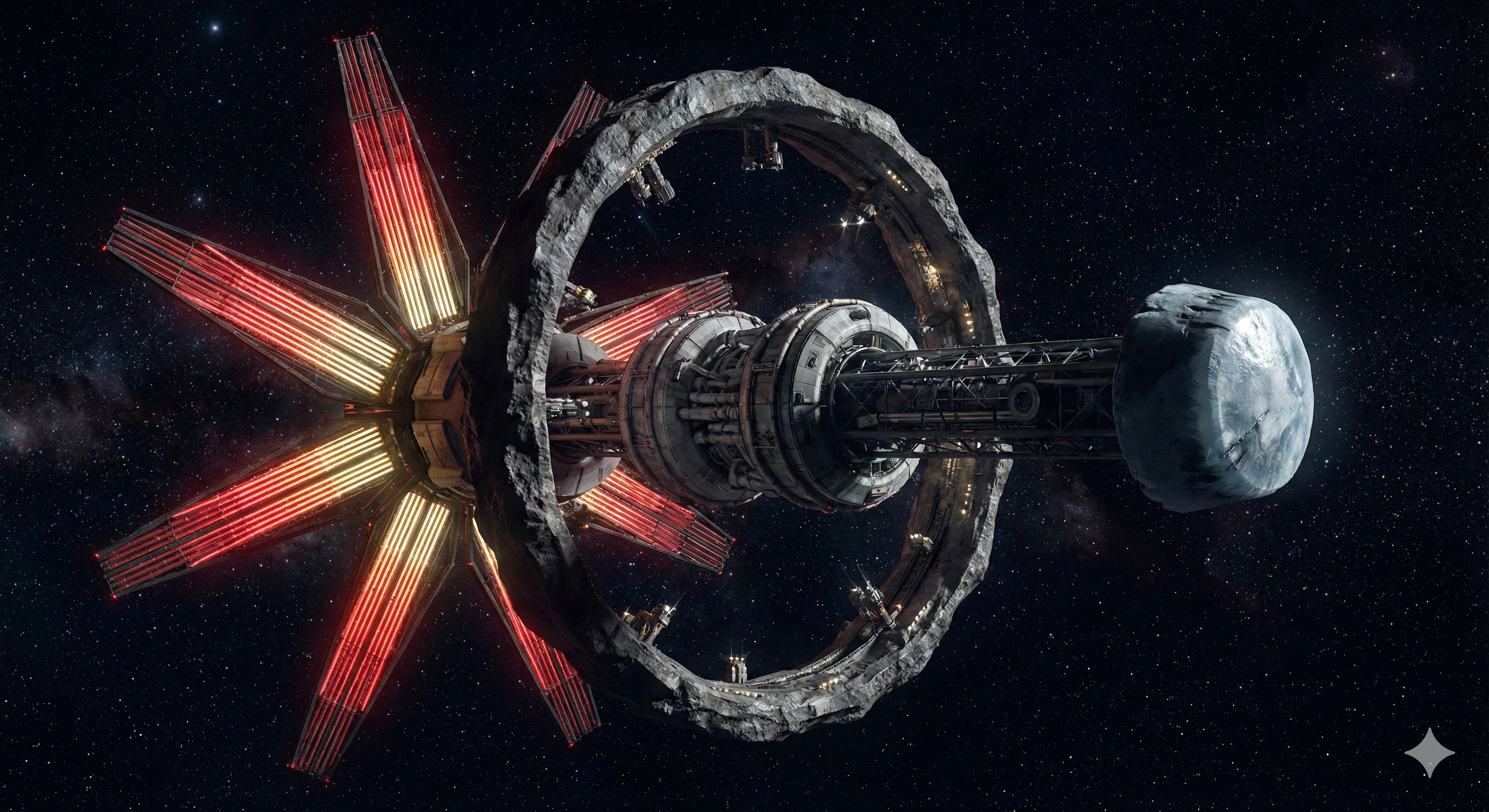
It was a jagged, hollowed-out asteroid of immense scale, its exterior a chaotic landscape of iron and silicate, its interior a cathedral of desperate technology. To maintain the gravity necessary for the delicate synthesis of life, the massive rock rotated with a violent, grinding grace. But at its dead center lay the Silent Core—a non-rotating cylinder of absolute stillness where the stasis pods were suspended like glass cocoons.
Ambrosio III stood on the catwalk of the Core, his heavy boots silent on the cold grating, the dark fabric of his flight suit absorbing the dim emergency lighting. Through the reinforced silicate viewports, the dead Earth hung in the distance—a bruised marble of ash and toxic clouds, a tomb for eight billion souls.
In the lab below, Ambrosio III slammed his fist against the synthesis console. His knuckles, dense with bone, didn’t even bruise, but the metal casing cracked.
“Why is it not working?” he roared, the sound tearing through the lab like a physical thing. Metal hissed where his fist had met the console; a hairline fracture spidered across the display, distorting the genome readouts into a smear of static.
The AI flickered onto the monitors, its usual sardonic geometry softened by something that resembled patience. [Junior, calm down. Breaking equipment won’t rewrite the laws of biology. You can’t brute-force a problem that’s baked into cellular inheritance.]
Ambrosio III stalked the catwalk like a predator with no kill. “I checked the Altamura markers myself. Cleaner than the one used for me—no contaminant sweeps missed, no splice misaligned. The archaic anchors are all there. Why do female gestations collapse into necrosis while male templates complete?” His voice scraped; the question was wrought with a desperation that made the steel of the rail beneath his hand feel warmer.
The projection sighed, and when the AI explained, it did so without sarcasm. [Think of the human genome as a software codebase. For centuries, we used CRISPR to patch the Rot, fixing bugs as they appeared. But every edit introduced ‘technical debt’—tiny, off-target mutations. Over generations, these accumulated. We call it ‘Cascading Genetic Entropy’. The code is now so convoluted that it collapses under its own weight during complex cell division. That is why our male syntheses succeed—the Altamura Y-chromosome is ‘Legacy Code’. It is archaic, unpatched, and simple. It acts as a stable anchor. Female embryos require two X chromosomes to stabilize, but the modern X is riddled with centuries of patch-work errors. When they try to pair, the error rate spikes, and the embryo terminates.]
Ambrosio III’s hands curled into fists. “So host stem cells in the suppressants won’t solve it?”
[They stabilize the symptoms, not the source code. You survived because the Altamura Y provided a stable kernel. To resurrect Sibyl, or any woman, we need a donor whose X-chromosomes haven’t been spaghetti-fied by three centuries of panic-editing. Long-range scans show one signal: a woman who died a century ago appears to have had a clean genetic baseline. There are no known living donors left.]
Silence fell for a beat too long, the kind of silence that presses the chest flat. Around them the Silent Core hummed, indifferent.
Ambrosio III stared at the holographic genome, the weight of the AI’s words settling like lead in his chest. A dead donor from a century ago was no solution—they needed living tissue, stable X-chromosome architecture. But the AI’s mention of the Rot’s progression triggered a darker thought. There was one last option, one final source of knowledge before they truly became a ship of ghosts.
The argument was cut short by a sound that hadn’t been heard on the Epilogue in decades: a Long-Range Telemetry Alert.
“Transmission?” Ambrosio III lunged for the comms array.
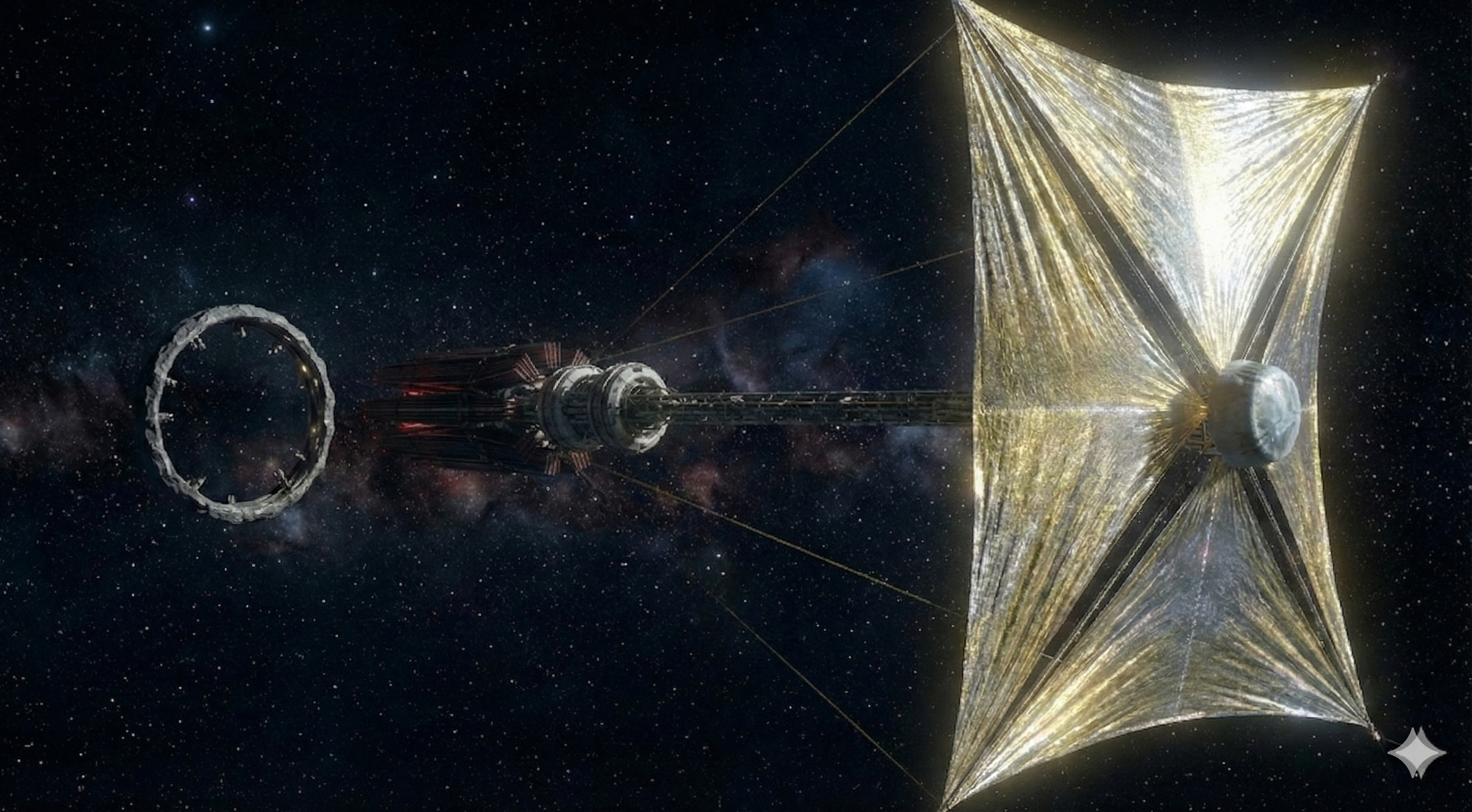
[Origin: Teegarden b exploratory team,] the AI reported, his snark replaced by a chilling precision. [The ‘Sails of Hope’ expedition. They left a century ago using a hybrid light-sail and nuclear propulsion system. The transmission has been crawling through the dark for twelve years.]
The audio crackled to life, thick with static, a voice from a dead era: “…confirmed. Atmospheric saturation… biological markers… Life. There is life here. It’s green… God, it’s so green. We are landing. Probes are failing upon entry—ion interference—but we are going down. If you hear this… follow us.”
Ambrosio III leaned closer to the speakers, his reflection warped in the glass of the dormant stasis pods. “What a beautiful planet,” he murmured, the static’s echo lingering like a ghost in the chamber.
[Yeah,] the AI muttered, its projection flickering with distorted edges. [A new world to corrupt.]
“Or preserve.” Ambrosio’s fingers brushed the cold screen. “We could have seen this in real-time if they’d carried Quant-Com systems.”
[Spoiled child,] the AI chided, though its tone carried a strange warmth. [They rode sunlight and primitive rockets for a century. Let them have their analog triumph.]
The years stretched thin after that first transmission. Each cycle of the Epilogue’s rotation marked another empty day, the comms array silent as the grave. Ambrosio III wore a path in the catwalk grating, his eyes perpetually drawn to the frozen star charts.
“Explain this silence,” he demanded one rotation, slamming his palm against the core’s observation glass. “They had full sensor suites. Where’s the atmospheric data? The biological surveys?”
[You assume they survived to send it.] The AI’s voice softened, its geometric patterns flattening into mournful planes. [That journey would have strained even our systems. Their flesh was fragile, Junior. Always so fragile.]
Ambrosio III’s jaw tightened. “Foolish of you to assume-”
[Foolish of me?] The AI interrupted, its edges sharpening. [Look at Dan’s readouts. His cellular decay mirrors theirs. The Rot takes everything but the stubbornness.] A hologram flickered - spiraling DNA strands unraveling at the ends. [Even now, it eats at him.]
“Wake him,” Ambrosio III commanded, his voice cracking like the silicate viewports under solar stress. “Before the Rot claims what’s left of his mind.”
The thawing process screamed through the chamber - not revival, but violation of death’s threshold. Supercooled steam geysered from the pod’s vents, carrying the acrid stench of preservatives and decay. Twelve-inch thaw-needles wrenched free from Dan’s vertebrae with a sound like tearing cartilage, their tips glistening with spinal fluid that immediately froze in the cold air.
Dan didn’t awaken - he erupted. His skeletal frame arced like a drawn bowstring, tendons standing in sharp relief beneath paper-thin skin. When the pod ejected him, it wasn’t a fall but a collapse, bones clattering against the grating like ceramic shards. Ambrosio III caught him mid-descent, the Neanderthal ridges of his forearm cradling Dan’s wasting body with grotesque gentleness.
“Sibyl…” Dan’s voice emerged as a death rattle, his pupils swimming in corneas gone the color of spoiled milk. Cracked nails dug into Ambrosio’s bronze flesh. “You… alive? The synthesis… did she…?”
Ambrosio III lowered him onto a bench strewn with genetic charts, their edges curled from age. “Third iteration,” he corrected softly, turning Dan’s wrist to reveal the blackened veins beneath. “Sibyl sleeps on. We found the Wall.” His thumb brushed the commander’s pulse point - too fast, too faint. A dying bird’s heartbeat.
Dan coughed, a wet, rattling sound that shook his frail frame. “The wall? What wall?”
[The Entropy Wall,] the AI intoned, its hologram resolving into a double helix that looked frayed and knotted. [Consider our DNA as a collapsing building. We kept adding supports—CRISPR patches—to hold up the roof. But the foundation is rotten. The Eve lineage…] The projection highlighted strands snapping under tension. […is a closed loop of error-prone code. We bypassed it in male syntheses using the Altamura Y-chromosome as a structural pillar.]
Dan’s breath hitched as the hologram zoomed in on withering cells. “But the daughters-”
[-require the X-chromosome architecture, which is compromised beyond repair,] the AI finished. [Each female embryo attempts to compile the corrupted code and fails. Within hours, their cells dissolve into…] It displayed a time-lapse of collapsing tissue. […this necrotic slurry. We can forge armies of sons using the archaic Y, but even one daughter would require a donor with a clean genetic baseline.]
Ambrosio III stepped between Dan and the grim hologram, his shadow falling across the commander’s ravaged face. “Not if the Sails’ signal holds truth.” He gestured to the comms array where emergency lights strobed crimson. “An old transmission, Dan. From Teegarden b.”
“A century…” Dan whispered, his milky eyes reflecting the hologram’s decay. “It’s either they are in stasis as per protocol or they’d be dust.”
[The transmission took twelve years to reach us,] the AI corrected, its voice modulating to the faint rhythm of the signal’s static. [Carried by photons through the void until it found our receiver.]
The audio crackled to life, the static parting for a voice that was both alien and achingly familiar: “…confirmed. Atmospheric saturation… biological markers… Life. There is life here. It’s green… God, it’s so green. We are landing. Probes are failing upon entry—ion interference—but we are going down. If you hear this… follow us.”
Dan’s eyes closed, a tear escaping the corner of one milky orb. “Teegarden b… the garden…”
Ambrosio III felt a surge of hope, fierce and bright. “We have one shot jump,” he said, his gaze fixed on the red sun depicted on the star charts. “One jump. One synthesis attempt.”
Dan looked at the rows of suspended pods in the Silent Core—the elite crew, the last of the scientists, all grey and fading. To jump was to gamble everything on a century-old ghost story.
“The NLS drive is our only way, Junior,” Dan said, leaning heavily on the young man’s arm as they moved toward the bridge. “We use it, and we leave Earth behind forever. The pods will hold us through the journey.”
“Earth is already a grave, Dan,” Ambrosio III replied. “I’d rather die under a new sun than watch the lights go out in this one.”
They reached the bridge. The command chair waited, a throne for a dying king. Dan settled into it, his fingers hovering over the ignition sequence for the near-light-speed drive.
“The fuel is enough for one way,” Dan whispered, his voice barely audible over the hum of the Core. “One shot. No return.”
Ambrosio III nodded, sealing the fate of their journey. “Then we make it count.”
Dan’s fingers danced across the console, initiating the operational sequence. The procedure was methodical, precise—each step a prayer to the machine gods of physics.
[Initiating purge sequence,] the AI announced. [Asteroid shell detachment in T-minus three minutes.]
The massive grinding of the asteroid’s rotation began to slow. External cameras showed the jagged iron and silicate shell—their radiation shield and home for centuries—beginning to separate from the inner Core.
[Purge in progress,] the AI reported. [Jettisoning 87% of mass. Reducing structural load by 6,400 tonnes.]
Ambrosio III watched through the viewport as the outer shell peeled away like a dying skin. Chunks of iron and rock tumbled into the void, their momentum carrying them off in a glittering cascade. The Silent Core, now exposed, was a sleek cylinder of technology—no longer an asteroid, but a ship.
The massive radiator wings, which had glowed a dull cherry-red against the asteroid’s shadow, began to fold. They retracted alongside the solar arrays, pulling tight against the Core’s hull to minimize the inertial strain of the coming acceleration and eventual deceleration. Every unnecessary appendage was brought home, turning the sprawling station into a singular, focused projectile.
[Shell separation complete,] the AI confirmed. [Mass reduced to operational minimum. All systems nominal.]
The hum of the Core changed, becoming higher-pitched, more urgent. Without the shell’s inertia, the ship felt lighter, more responsive.
[Initiating stasis protocols,] the AI announced. [All crew to pods. Cryogenic suspension in T-minus five minutes.]
The Silent Core came alive with activity as the remaining pods activated. Ambrosio III watched through the viewport as the elite crew—scientists, engineers, the last of humanity’s knowledge—were drawn back into their glass cocoons. The thaw-needles retracted with hydraulic precision, sealing them in absolute cold.
[Power distribution commencing,] the AI reported. [Primary reactor online. Diverting all energy to NLS manifold.]
Lights flickered, then burned with intensity as every spare watt was fed to the drive.
[Velocity buildup initiated,] the AI’s voice took on a rhythmic cadence. [Sub-light acceleration phase. Current velocity: 0.05c.]
Ambrosio III felt the shift—a subtle pressure against his chest as the artificial gravity compensated for the building momentum. The stars outside began to stretch, their points of light elongating into lines.
[Phase two,] the AI intoned. [Velocity: 0.15c. Stasis pods engaged. Crew entering deep sleep.]
Through the viewport, Ambrosio III saw the pods glow faintly as their occupants slipped into unconsciousness. The journey would take years, but to them, it would be a single night’s sleep.
[Phase three. Velocity: 0.5c. Space-time curvature building.]
The Core’s hull groaned as the stresses mounted. The sleek cylinder was now a projectile, hurled across the void. The hum became a scream, felt more than heard.
[Phase four. Velocity: 0.8c. Approaching relativistic threshold.]
Ambrosio III stood at the prow, feeling the universe bend around them. The stars were no longer points but streaks of silver fire. The chant rose from his throat, primal and triumphant:
Ghost of the past, be still and sleep, Across the void, the promise we keep. Through the eye of the needle, the needle of fire, We trade the earth for the heart’s desire. The stars are the gate, the stars are the way, We break the night to find the day.
[Final phase. Velocity: 0.99c. Near-light speed achieved. All systems nominal.]
The Epilogue vanished from the solar system, leaving only an echo of thunder in the silence of the void. Inside the pods, the crew slept on, unaware that their velocity was now a fraction below light itself, carrying them toward Teegarden b and the promise of a new dawn.